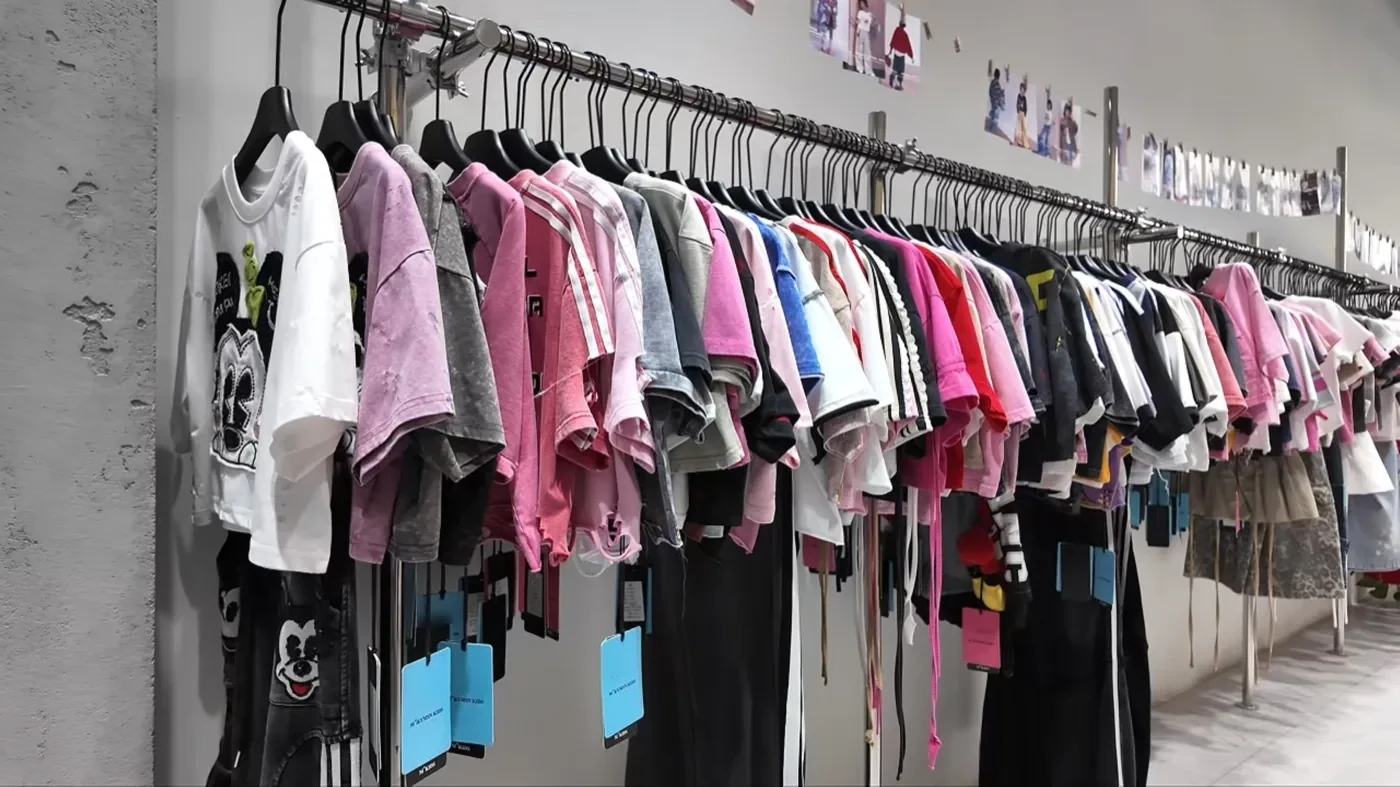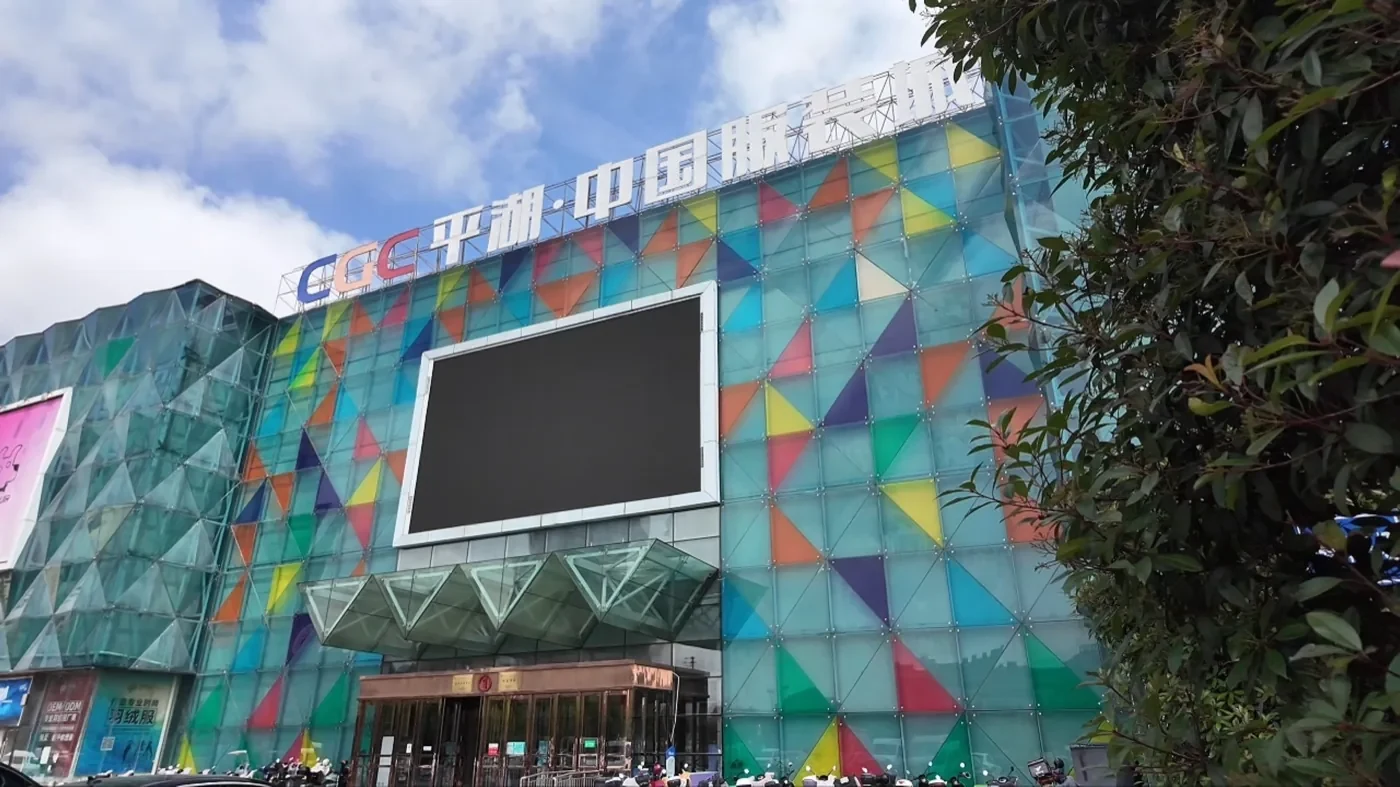
Tiger sourcing series: sourcing in Hangzhou and nearby manufacturing hubs.
If you have been buying winter clothing in China for years, you probably already have familiar suppliers and an established range. But sometimes a shop needs different silhouettes, an interesting fabric, or a collection customers do not see in every neighbouring window. For that task, I recommend taking a closer look at Pinghu.
I am Vera from Tiger Logistics. We support sourcing and arrange delivery from China, including work with down jacket suppliers in Pinghu. In this article I share what I see on sourcing trips: why to attend new-collection presentations, who can benefit from surplus stock, what to settle before production starts, and why packaging can matter as much as the purchase price.
The technical explanations and price example below draw on public materials from the industry association and testing specialists. The comparison of purchasing approaches and order stories come from our own work. That experience helps prepare a trip, but choosing a particular style still starts with your customer, budget, and selling season.
Why visit Pinghu if you already buy at Yabaolu?
For many Russian buyers, Chinese winter clothing is closely associated with Beijing's Yabaolu. Over the years, established relationships have developed there between trading companies, factories, and buyers. Suppliers we know often started taking autumn and winter orders in spring, and spring orders in autumn. The exact calendar depends on the company and collection.
This system is convenient when a shop has stable demand for particular styles. Manufacturers receive orders from several sellers, so similar items may appear in different showrooms. For clients who need familiar cuts and predictable purchasing, that is not necessarily a disadvantage.
I see Pinghu primarily as another place to find designs and manufacturers. On our trips we see interesting women's, men's, and children's collections, varied textures, distinctive collars, and different finishes. Some shops need exactly these products to refresh their offer and support a higher retail price.
There is also public evidence of this interest in original design: Pinghu's administration reported the opening of an original-brand area in the local trading complex back in 2021. That does not mean every product in the city is unique; suppliers and particular collections still need individual assessment. [1]
If you need an inexpensive jacket with synthetic insulation, compare offers against the same specification, including from manufacturers you already know. A city's name does not guarantee a better price. If you are looking for a new silhouette, another fabric, or the option to change the filling, a visit to Pinghu provides concrete choices to evaluate.
When to visit: a new collection or surplus-stock sales
In our experience, these are two different trips. You attend a new-collection presentation to plan the season and place an order. You look for surplus stock to buy an existing batch, with its actual sizes, colours, and condition. Avoid combining both into an expectation of buying the newest styles very cheaply.
| Purchasing approach | When to plan | What the buyer selects | What to check first |
|---|---|---|---|
| Ordering a new collection | Some of our suppliers hold presentations in May–June; dates are confirmed with the organisers | Styles for the coming season and agreed specifications | Sample, minimum order, and production lead time |
| Buying surplus stock | After Chinese New Year; availability is checked for a specific date | Goods already available, rather than future production | Size assortment, condition, and available quantity |
May and June are a guide from our visits to particular suppliers, not a single calendar for all Pinghu events. Before booking flights, we match the client's objective to the relevant presentation dates. Also distinguish the factory's dispatch date from the date goods reach your shop: inspection, packaging, and transport follow production.
What a presentation offers
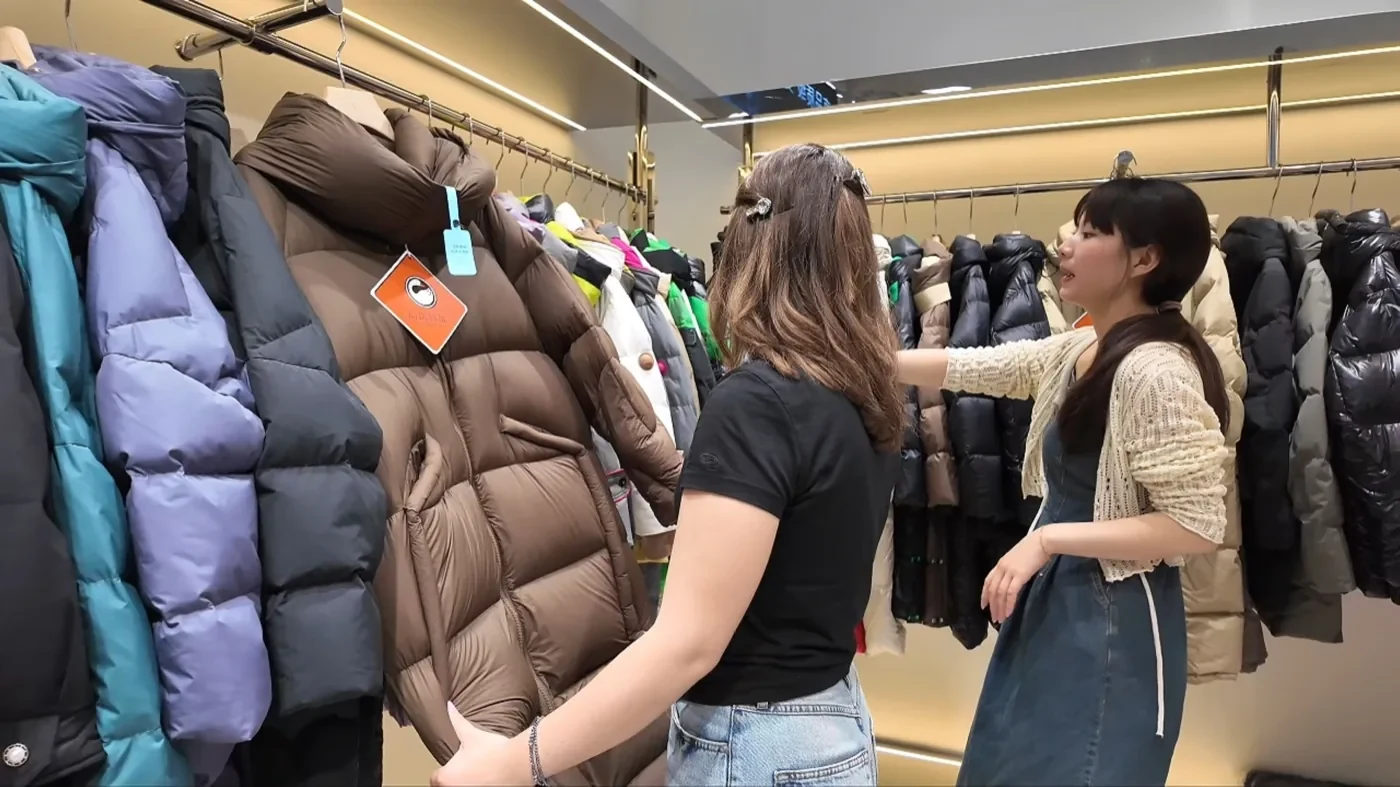
Some suppliers stage a full presentation with a large runway, models, and new combinations of fabrics and finishes. You can see how a garment fits and moves, then examine it closely. For me, these meetings are a chance to look beyond a familiar catalogue and see what we would like to offer our clients.
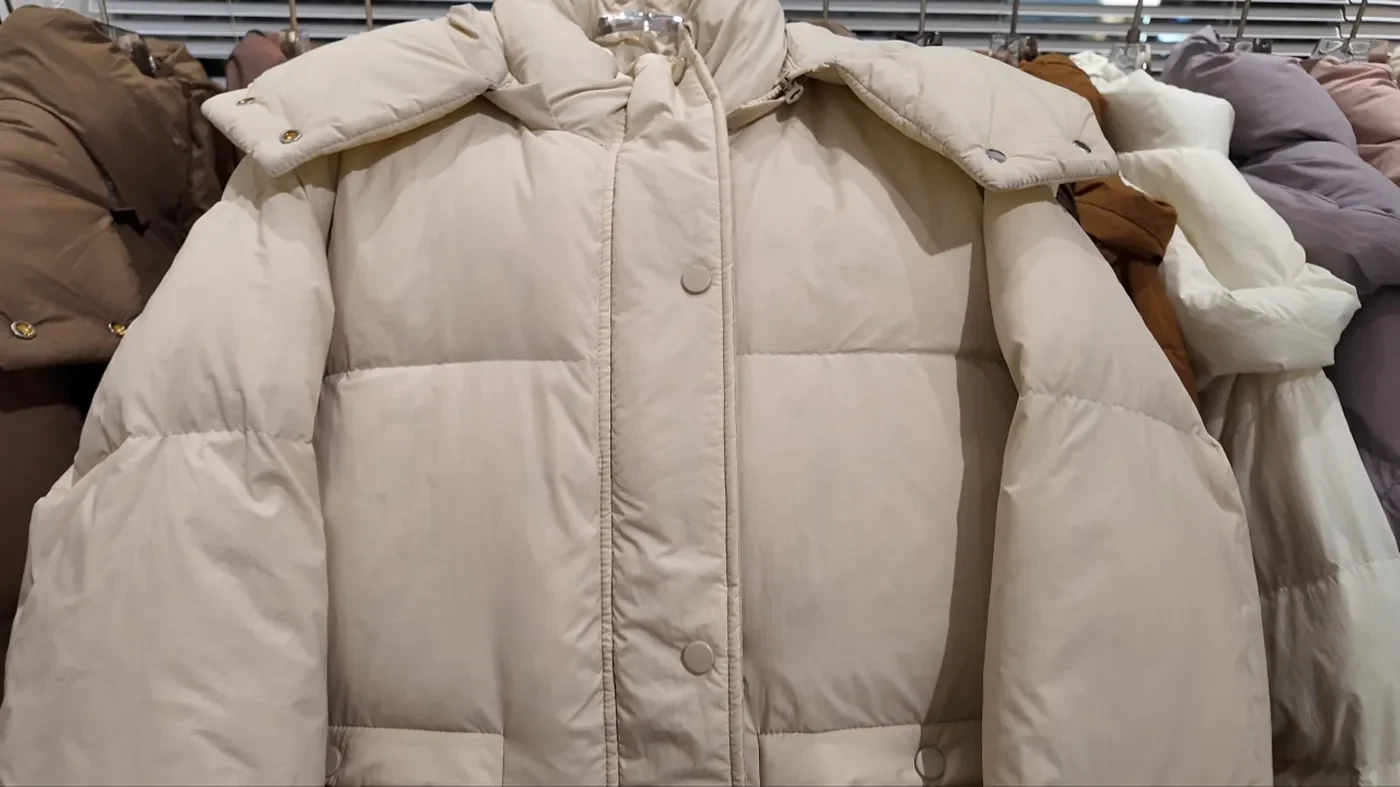
Styles with distinctive collars, unusual matte textures, and good proportions are particularly memorable. But an impressive runway appearance is only the beginning. For purchasing, you must establish which sizes will be made, how the item looks without stage lighting, and what the agreed version will cost.
Channel-specific collections, regional protection, and buying a design
Brands may reserve collections for particular sales channels and agree regional protection. This matters to shop owners who invest in selecting a range, photography, and window displays and want to know where else the same product will be sold.
In our negotiating experience, some styles shown at in-person presentations may be reserved for particular clients. Buying exclusive rights to one style can also be discussed. None of our Russian clients has yet completed a purchase of an entire design; ordinary collection orders are more common in our daily work.
We therefore do not promise that a jacket you like will never appear online. Before ordering, clarify exactly what the brand offers: a territorial, channel, or sales-period restriction, or access to particular items. These terms must apply to your style and order rather than remain a general impression from the presentation.
95% down, fill weight, and fill power: what to compare
“I want the warmest jacket with 95% goose down” is understandable as a buyer's wish, but insufficient as a production brief. Composition percentage, filling quantity, and loft describe different properties. In Chinese documents, distinguish 绒子含量—the down-cluster percentage—from 充绒量, the garment's fill weight. [2]
| Parameter | Meaning | What to request for an order |
|---|---|---|
| Composition and down-cluster percentage, % | The proportion of filling made up of down clusters; goose or duck is specified separately | Exact material description, declared percentage, and material documentation |
| Fill weight, g | The amount of filling in a particular garment | The fill weight for the agreed size, not just the jacket's total weight |
| Fill power, for example cuin/oz | The volume occupied by a specified mass of down under defined test conditions | Value, units, test method, and sample preparation |
| Fill distribution and shell | How the garment is constructed and retains its filling | Sample, evenness of filling, outer fabric, and agreed checks |
The IDFL laboratory treats composition, bird species, fill power, and fill weight as separate measurements. “95%” alone is therefore neither a temperature rating nor a guarantee that one finished jacket is warmer than another. Warehouse inspection helps identify visible discrepancies but does not replace laboratory testing of down composition. [3]
To compare two quotations, request the same sample size and the same set of specifications. A number on a label is of little help if one style has a different length, filling, or substantially different material quantity. Fill-power test conditions must also be comparable: sample preparation and condition affect the measurement. [4]
If you replace down with synthetic insulation, cost it as a separate version of the garment. Agree the composition, material weight or density, fit, and sample. This gives the factory an actual specification to discuss, rather than merely a request to make the same jacket cheaper.
What makes up a down jacket's wholesale price?
Filling is only one component of the cost, but it illustrates why outwardly similar garments can have different prices. As a reference, we use a specific published market snapshot rather than an unknown seller's advertisement.
The China Feather and Down Industrial Association's review for the fourth week of September 2026 gives average raw-material prices under GB/T 14272-2021: 90% white duck down at RMB 559.4/kg and 90% white goose down at RMB 972.8/kg. The source was published on 24 September 2026. This is a historical raw-material market reference, not today's quotation or the price of a finished jacket. [5]
| Raw material under the same specification | Average price, RMB/kg | Illustrative 200 g, RMB |
|---|---|---|
| White duck down, 90% | 559,40 | 111,88 |
| White goose down, 90% | 972,80 | 194,56 |
The last column is our arithmetic example: the kilogram price multiplied by 0.2. The difference is RMB 82.68 for the illustrative raw-material quantity alone. It excludes wastage, fabric, trims, sewing, finishing, packaging, and delivery. The 200 g quantity is used for calculation, not recommended for every winter jacket. These prices for 90% material must not be applied to material declared as 95%.
A practical comparison is to request the same style in two or three agreed specifications. You can then see what the extra cost covers: outer fabric, filling, collar, trims, or a smaller batch. The lowest price without a breakdown does not explain which product the shop will actually receive.
Matching a style to your shop's customers
The following are pointers from our sourcing experience, not statistics on material preferences in Russia. Expensive filling does not create demand by itself. Customers assess the whole garment, and shop owners need to understand which price and range they can sustain.
| Your business format | What to consider | What to ask the supplier |
|---|---|---|
| A shop with a higher average transaction value | Fit, distinctive design, finishing, and verified materials | Can we agree the specification and obtain a matching sample? |
| An everyday clothing shop | Familiar styles, size range, and final purchase cost | Which versions fit our budget? |
| A seller with an established product listing | Consistency of the style and specifications | Can this exact version be reordered after the first batch? |
| A wholesaler working with surplus stock | The lot's actual contents, condition, and options for distributing different sizes | What exactly does the batch contain, beyond its average price? |
If you are also refreshing a women's clothing range, the visit can be included in a sourcing itinerary supported by Tiger. It is better to allow time for specific suppliers in advance than to try to see the whole city and place a complex order in a single day.
After choosing a style: preserving the order requirements
Decisions at a presentation happen quickly: you like the silhouette, fabric, or colour. Production must preserve each of those details. Our orders raise questions about shades, materials, inspection requirements, and deadlines. We help agree these points and keep the discussion tied to the particular batch.
Before production starts, collect the item number, approved sample, colour, fabric and filling composition, sizes, quantity, configuration, and dispatch deadline in one place. Separately discuss what happens if the factory proposes a material substitution or reports a delay. This is practical order preparation, not a promise that production will never deviate from the plan.
When an order for black jackets turned out dark brown
In one order, our client selected black down jackets. During an interim review, we discovered that the factory had made dark-brown garments. We contacted the manufacturer and worked to resolve the issue. In the end, we secured dispatch within the agreed deadline.
The client thanked the team and later introduced us to two more partners. For me, the value of this story is that the discrepancy was found while it could still be addressed in China. It is important to revisit the agreed requirements during production rather than simply pass on an order and wait for finished boxes.
If you need a customised version, we start by discussing made-to-order production. An attractive showroom style is not automatically available with any change and in any quantity. Volumes and specific alterations must be discussed with the selected factory.
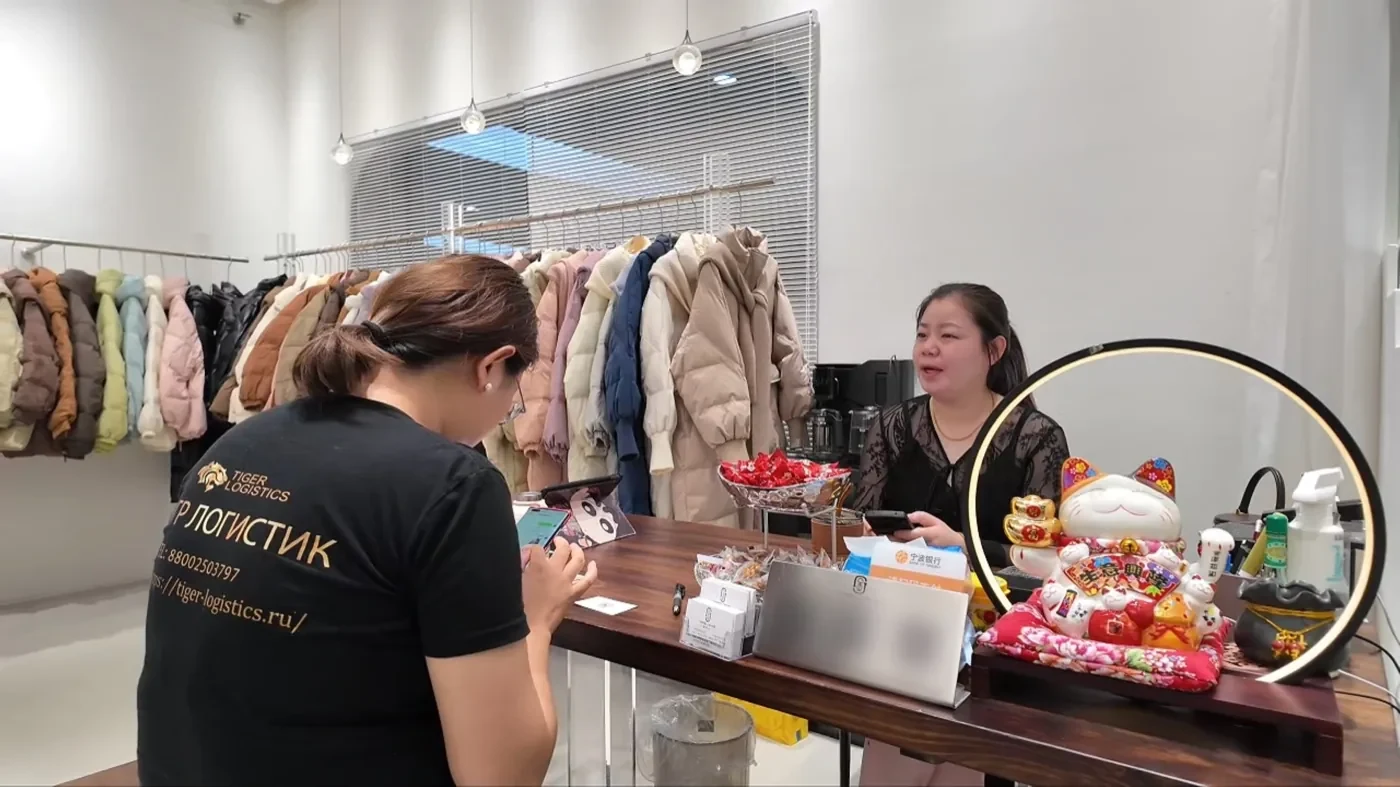
Surplus stock after Chinese New Year: who is it suitable for?
After the holidays, suppliers may offer very attractive surplus-stock deals. Tiger gathers offers for clients interested in this format, including down jackets and other clothing categories. But a photograph and a low price do not describe an entire batch.
Surplus stock has three practical difficulties. First, size ranges may be incomplete. Second, condition can vary within the same batch. Third, the available lot may sell while you are discussing the purchase. Price, availability, and batch contents must therefore be considered together.
An experienced wholesaler may find this stock suitable: they know how to assess a lot and distribute the range through their channels. For someone who has just opened a small shop and expects complete size runs without additional work, I would not recommend starting with surplus stock purely because of the discount.
Calculate the cost per unit suitable for your sales format, not just per unit purchased. Include the batch itself, inspection, packaging, transport, and the actual number of garments you can sell. Unsuitable sizes or defective items can affect the economics more than the initial discount.
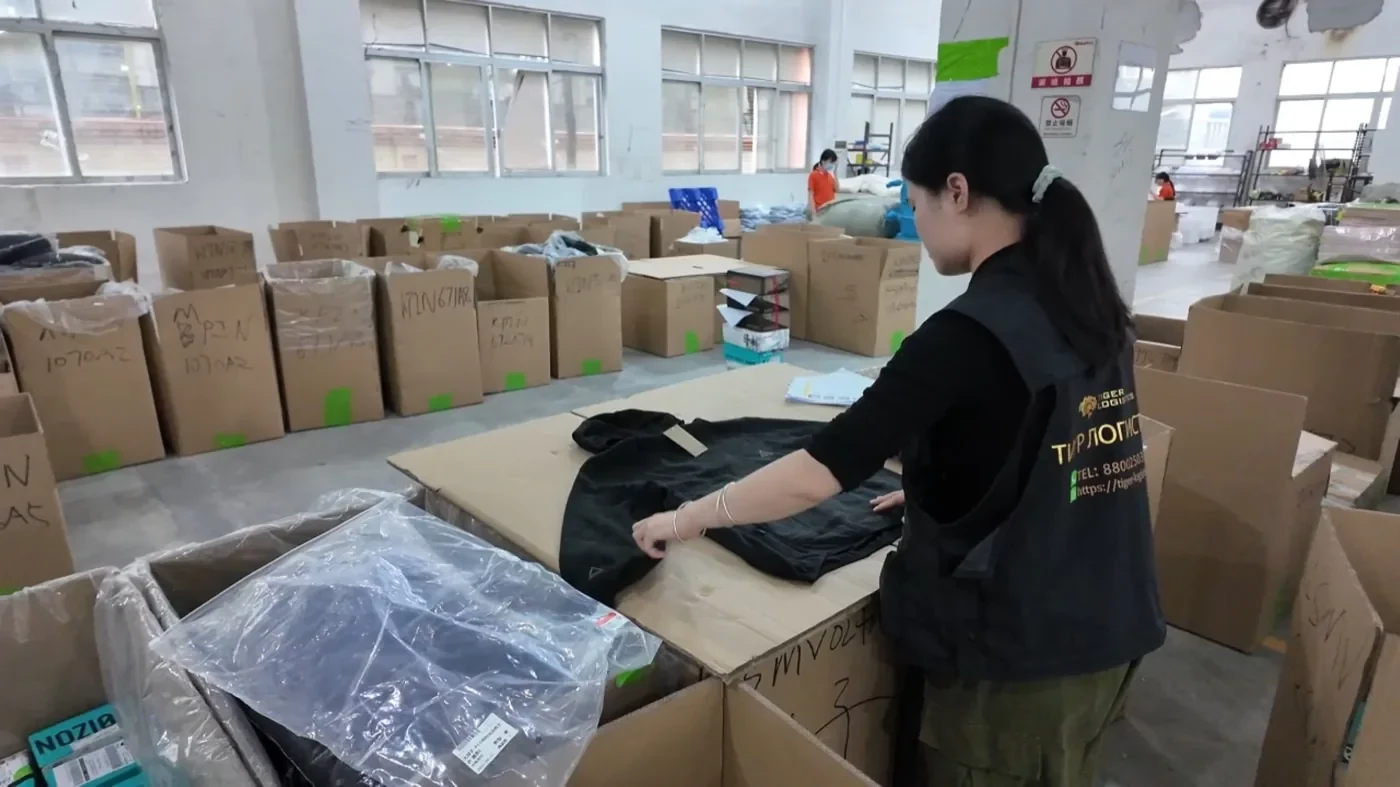
If you are already visiting China, it is useful to inspect this stock in person. Seeing it makes it easier to decide whether this format suits you in future. For remote purchases, it is especially important to agree what we inspect and the checklist used to receive goods at Tiger's warehouse.
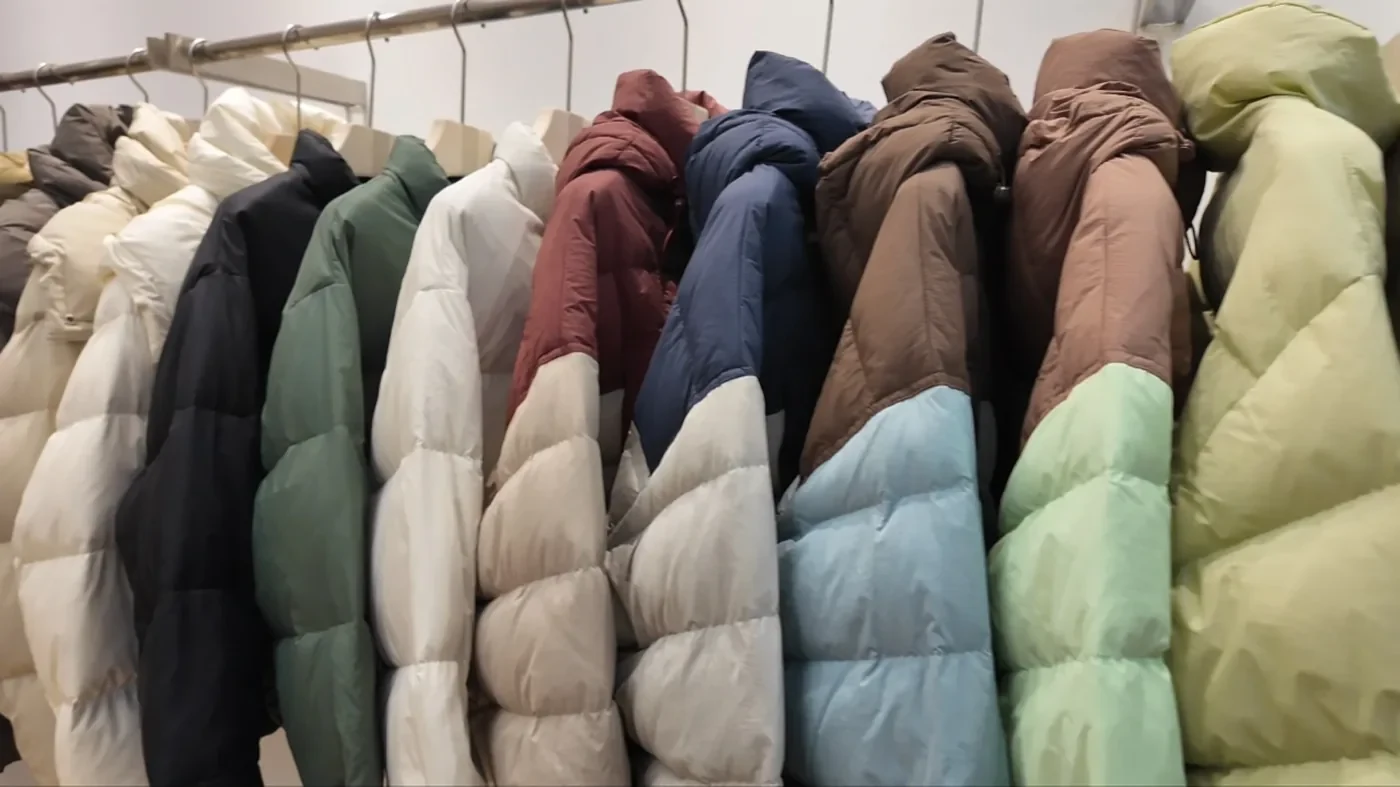
Packing down jackets: our experience with compression and damage
Down jackets take up considerable space relative to their weight. Before shipping, check the actual package dimensions and the chosen carrier's pricing terms. Reducing volume may lower transport cost, but it only makes sense if the goods remain intact.
We had an unfortunate experience: in an effort to reduce a client's costs, we heavily compressed the cargo. Plastic zipper parts and snaps were damaged. The volume savings did not justify the result, and Tiger compensated the client for the damage caused by our packaging error.
We changed our approach after that. We now use bags with air removed and provide separate protection for zipper components and collars, with preparation agreed with the supplier. Specialists handle the practical details, but the principle for clients is simple: packaging is chosen for the particular garment and its finishing.
Cargo readiness cannot be judged solely by how compact a bag has become. The product the client chose and paid for must be preserved. When discussing road freight from China or another route, we consider packaging and freight pricing together.
How we handle damage caused by our own fault
If damage is caused by Tiger, we accept responsibility and fully reimburse the goods' loss in value caused by us. The amount is based on the actual loss in value; damage to part of a batch does not automatically mean payment for the entire undamaged remainder.
Insurance and our responsibility for our own error are separate matters. The insurance option described here covers loss of cargo but excludes damage. This describes that particular option, not a rule for all cargo insurance. The chosen coverage must be clarified before shipping.
Transport involves difficult situations. What matters to me is that each one leads to a specific improvement in how our team works. These decisions build the experience that brings clients back to us.
Frequently asked questions about buying down jackets in Pinghu
Can I order a small batch?
A small batch can be discussed with a suitable manufacturer. Terms depend on the style, material, and requested changes. Send an example and quantity so that we can start with a specific enquiry, without promising one minimum for every factory.
When is the best time to see a new collection?
Some of our suppliers hold presentations in May–June. We first confirm the relevant event dates and production lead times, then plan the trip. This is a guide from our experience, not a calendar covering every Pinghu supplier.
Does 95% goose down mean a jacket is the warmest?
No. Composition percentage must be considered alongside fill weight, fill power, and the finished garment's construction. Request an exact specification and appropriate evidence of the properties when ordering.
Can down be replaced with synthetic insulation?
This version can be discussed with the factory. Material, sample, quantity, and price must be agreed again. The finished product's name and description must match its actual filling.
Will a style purchased at a presentation be exclusive?
Some brands offer channel-specific collections and regional protection. Buying rights to a style can also be discussed, although none of our clients has completed such a purchase yet. Confirm terms for the particular item; attending a presentation does not itself grant exclusivity.
Should a new shop start with surplus stock?
I would first assess the buyer's experience and ability to work with incomplete size ranges and varying garment condition. For a small shop, a low lot price may not offset an unsuitable range and delivery costs.
Can down jackets be heavily compressed to reduce freight costs?
We remove air from bags while considering the goods' characteristics and protecting vulnerable parts. After our own experience of damaged trims, we do not treat maximum compression as a universal objective.
What happens if Tiger causes damage?
We fully reimburse the actual damage to goods caused by our error. Payment corresponds to the damaged goods' loss in value. Insurance coverage is discussed separately and does not replace this responsibility.